
Charles Industries, Ltd. Home Page -  to download a company logo, please go to www.charlesindustries.com/logos.htm
About Charles Industries
New Product Information and Media Coverage
The Latest Corporate and Product News
Customer Satisfaction and Continuous Improvement
A List of Shows Charles Will Be Attending
 
OSP (Outside Plant) and Access & Transmission Business Units
AC and DC Matched-Component Power Systems, Battery Chargers and Isolators, C-Cable Products
Transformers, Industrial Battery Chargers
 
Technical Support, Customer Service and Repair Information
List of Authorized Distibutors
Literature Request For Charles Industries
Email Newsletter Subscription For Charles Industries
Employment Opportunities with Charles
Keyword Search of Entire Charles Website

Navigational Guide for Charles Website

E-mail Information by Department


Passing Out of the Deployment Slow Lane


Lengthening DSL's Reach Helps Bridge the Geographic Digital Divide


  By Brad Wackerlin


If you’ve taken the time to sift through your mail lately, chances are a solicitation for digital subscriber line (DSL) services is right there between your Pottery Barn catalog and Platinum Visa offers. Carriers such as Mindspring, SBC Communications, Juno and Northpoint boldly pitch claims of faster access and downloads, but the cold, hard truth is that up to 60 percent of U.S. households aren’t located close enough to a phone company’s central office to receive ADSL.
            So what’s a carrier to do? Subscribers aren’t balking at shelling out hundreds of dollars for DSL installation and subscription fees. They’re just begging for quick access and reliable speeds. With such a lucrative pool waiting to be tapped, carriers are bending over backward to find new ways to bring DSL to the masses. The stakes are high, and carriers must now compete with cable and wireless vendors in many markets. In metropolitan areas, with central offices in close proximity to one another, the connections are in place to provide DSL services immediately. In suburbs and rural areas however, where copper lines are the norm, extending broadband is a much more difficult and costly proposition.
           
In their rush to meet customer demand and cash in on potential profits, ADSL providers are making decisions that will have far reaching impacts on their bottom lines. Carriers must contend with demanding ADSL deployment schedules in an effort to keep their customers happy. Given their time restraints, carriers often choose a deployment strategy of laying new fiber/copper hybrid systems. The costs associated with this type of deployment are extremely high due to labor, materials availability, and land rights. These costs may be justifiable when deploying services to a new subdivision, for instance, but not economically feasible in servicing rural areas. That’s why carriers choose to focus their efforts on key metro areas and the availability of ADSL services in rural areas remains a rarity.
            To tap rural markets and provide a short-term solution to areas on the ADSL waiting list, carriers must either have a supply of available circuits or embrace new technologies that expand the capabilities of existing lines. Recent developments in multiplexing systems may hold the answer.

            DSL multiplexers are a recent innovation allowing a single twisted pair to carry both voice and data signals at DSL speeds over extended distances. The first to market these devices were established transmission products manufacturers Charles Industries and AG Communication Systems. Others are sure to follow as carriers recognize the immediate revenue opportunities that high-speed multiplexers can bring once implemented into their subscriber loops.      

High-Speed Mulitplexer RT
and COT Line Card

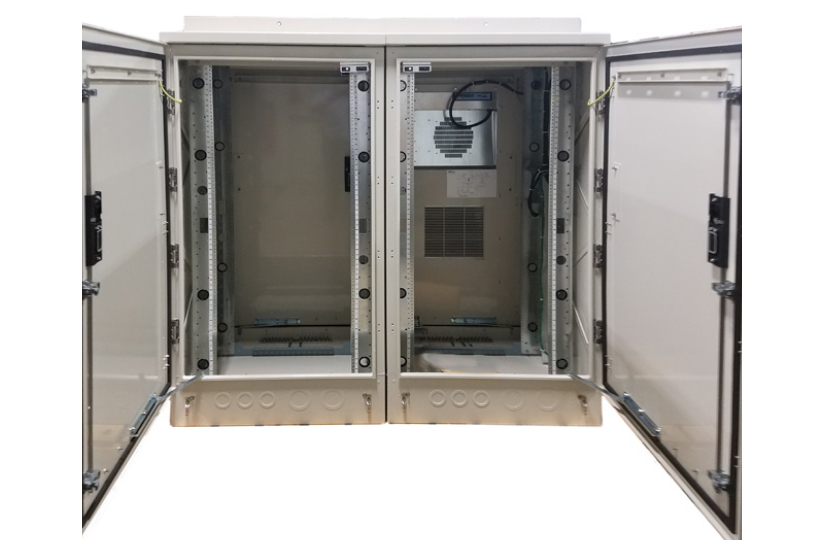
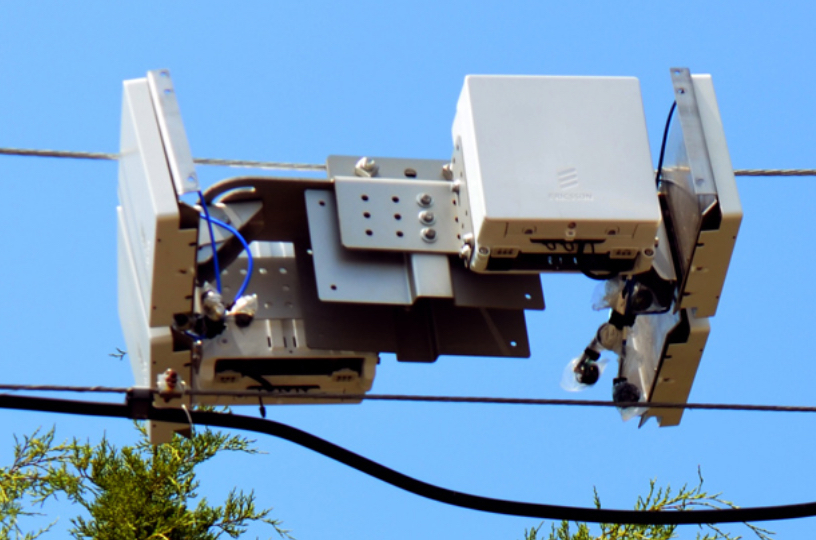
            The typical high-speed multiplexer system includes a line card installed at the central office and a RT (remote terminal) at the customer premise. The COT line card is installed into a standard 19” or 23” rack enclosure at the central office or in weatherproof remote location. At the customer premise, a corresponding RT module allows the drop of both voice and high-speed data lines. Repeaters may be installed along the line to extend reach as far as 40,000 feet from the central office, a distance well beyond the 14,000 to 18,000 foot reach common to most providers’ DSL services. That equates to lengthening the broadband “copper road” from two-and-a-half to seven-and-a-half miles.

            Charles Industries’ High-Speed VDL 3.1 System is one of the newest examples of a DSL multiplexing system. The High-Speed VDL 3.1 enables a single copper pair to deliver three voice channels and one high-speed Internet data channel to small businesses and residential subscribers. The system multiplexes three 64 Kbps clear channel, toll-quality voice lines and one high-speed, ADSL-compatible data line for transport. Then, by utilizing low-noise, line powered equipment, the system demultiplexes the signals at the subscriber’s RT.

Charles Industries' High-Speed
VDL 3.1 Multiplexer System

            Depending on the application and wire gauges, as well as the use of repeaters, the system can deliver 1 Mbps of symmetrical data for the full distance of up to 40,000 feet. The kicker is that unlike conventional ADSL, the bandwidth of the High-Speed VDL 3.1 is not degraded by distance. Thus, all subscribers, regardless of their distance away from the COT, enjoy reliable, symmetric throughput when surfing the World Wide Web.

            In suburban and rural areas, the High-Speed VDL 3.1 is an ideal solution to providing DSL subscribers a high-speed Internet access line, while maintaining voice and fax lines on the single copper pair already servicing their household. System components are temperature hardened, making them ideal for installation in remote configurations.
   
         High-speed multiplexers offer a prime opportunity for carriers to add new and upgraded services to subscribers, especially SOHO customers. Many small businesses and at-home telecommuters require multiple voice lines and one high-speed connection to the Internet. Without the expense of laying new copper, a carrier can leverage their existing copper investment and provide immediate fulfillment of customer orders. The point of demarcation lies outside the customer’s premise (at the RT), so service and line testing can be performed without scheduling a maintenance visit. Subscribers save as well because no desktop modem is required. The system is compatible with all analog modems and supports advanced CLASSSM services across all voice lines, ensuring customers continue to receive the enhanced services to which they are accustomed.
   
         As competition to provide high-speed Internet access to business and residential customers intensifies, carriers willing to embrace new advances in multiplexing technologies will have the advantage over carriers whose approach is to just plow more cable. The “Plow More Cable” strategy often involves long lead times, which will only add to the frustration already harbored by the many would-be DSL subscribers already on waiting lists. Another obstacle with this strategy is the cost involved. Adding more lines is prohibitively expensive in legacy urban infrastructure, and not a viable solution in outlying areas.
   
         For outside plant professionals, high demand for DSL services and aggressive deployment schedules have meant longer hours in the field and added stress. The installation process is tedious, and requests for DSL are compiling faster than the orders can be filled. A plug-and-play high-speed multiplexer option accelerates the installation process and helps carriers fill their DSL requests faster. Shorter lead times keep current customers from jumping ship in hopes that another provider can fill their service requests in less time. As many providers have discovered, its nearly impossible to lure back a subscriber once they have been lost to a competing provider.
   
         Carriers welcome technologies that improve service and increase operating efficiency, and multiplexers excel in this area. When evaluating high-speed multiplexing systems, it is important to look for key features that will enhance deployment and service. Systems that include configuration software allow technicians to verify that the configuration, wire gauge and segment distance do not exceed power limits without having to step foot in the field. Another important feature is line testing signatures. Once a multiplexing system is installed, line testing signatures allow technicians to quickly determine if a problem lies in the carrier’s line or within the customer’s premise wiring.
   
          The demand for DSL services offers many opportunities to carriers while at the same time presenting several challenges. The industry is making fast and furious strides to improve the availability of DSL services in all parts of the country. While suburban and rural areas may lag behind easily accessible urban areas, it is no longer out of the question that everywhere a voice line goes, a high-speed Internet line can follow. Thanks to forward-thinking companies and new technologies, DSL may reach its full potential well ahead of industry experts’ predictions. Today's customers who view DSL as being stuck in the  "Deployment Slow Lane” will finally be able to merge onto the information superhighway. And to everyone's surprise, that highway may just well be our old, familiar "copper road."


Brad Wackerlin is a technical communications specialist for Charles Industries, Ltd. For more information, call (847) 258-8406, or visit www.charlesindustries.com.


Typical High-Speed Multiplexer System Configuration


Back to Top
  About Charles |
| What's New | TL/ISO 9000 | Search | |Order Status  | Telecom Group | Marine Group | Industrial Group | Careers | Literature Request | Support | Site Map | Privacy Statement | Contact Charles


0